
How often to clean solar panels depends on what lands on them. For most homes on the Main Line, the answer is once a year, in late May or June, after the spring tree pollen ends. An array under oak or tulip poplar canopy can need a second cleaning in late fall, after the leaves are down. A steep array in full sun with no visible film can frequently skip a year, because rain carries off loose dust.
Should I clean my solar panels?
Clean them when one of these is true, not because a calendar says so:
- You can see a yellow-green pollen film or a gray haze on the glass from the ground.
- Bird droppings sit on the panels. A single dropping counts.
- Leaves, seed pods, or pine needles collect along the lower edge of the frame.
- Your monitoring app shows lower output than the same month last year, in similar weather.
The monitoring app is the best test you have. A cloudy month always produces less, so compare against a month with similar sun, not against last week. If production holds and the glass looks clean, leave the panels alone. Each cleaning puts water and a person near the array, and neither is free of risk.
Bird droppings are the exception to "wait and see". A dropping is opaque, so it shades part of a cell. That lowers the output of that panel, and on a string inverter system it can also pull down the panels wired with it. Droppings also harden in summer heat and get harder to remove each week.
What dirties panels on the Main Line
Each season here leaves a different type of soiling. That is why one cleaning a year, timed well, does most of the work.
Spring brings tree pollen from about late March into June. It settles as a fine film, and morning dew turns it into a paste that dries onto the glass. A light rain then moves it into streaks at the lower edge instead of off the panel. Our guide to seasonal pollen on Pennsylvania home exteriors covers how it collects on siding and decks too.
Summer adds dust and birds, and the humid weeks keep the glass damp for longer each morning. Arrays near a busy road such as Lancaster Avenue also collect road grime.
Fall is about leaves. Oaks hold their leaves late here, into late November in most years. Leaves and seed pods catch on the lower lip of the panel frame, hold water there, and give algae a strip to grow in. If the gutters below the array also fill, see how often to check gutters between cleanings.
Winter is mostly snow, and snow is not dirt. Tilted panels shed it as it melts. Do not scrape snow off the glass with a roof rake or a shovel. A metal or hard plastic edge can scratch the glass.
How often to clean solar panels, by array type
| Array | Typical interval | Why |
|---|---|---|
| Steep roof, full sun, no trees over it | Every 1 to 2 years, or when output drops | Rain removes loose dust, and pollen film stays light |
| Under or near mature trees | Once a year after pollen, plus late fall if leaves collect | Pollen and sap in spring, leaf litter in fall |
| Low-pitch or flat roof | Once a year | Water stands longer and dirt dries in place at the lower edge |
| Under a roost or a nest | When droppings show | Droppings shade cells and harden in heat |
A ground array is easy to reach, so you can clean it more frequently and with less risk than a roof array.
How to clean solar panels safely from the ground
This is the homeowner method. It removes pollen and dust. It does not give the spot-free finish of a deionized rinse.
- Read the cleaning section of the panel manual first. Manuals usually list the water pressure and the soaps that the maker says to use, and some tie the warranty to those rules. If the manual gives a shutdown procedure for cleaning, do it.
- Pick a cool time: early morning or evening, or an overcast day. Cold water on hot glass can crack it.
- Stay on the ground. Rinse with a garden hose and a normal nozzle, from the top edge of the array down.
- If a film stays, use a soft brush or sponge on an extension pole, with mild soap in a bucket of water. Do not use scouring pads, scrapers, or strong household cleaners.
- Rinse off all of the soap. Soap that dries on the glass becomes a film, and the next pollen sticks to it.
- Expect some spots. Tap water in this area is hard. When it dries on glass in the sun, the minerals stay behind as spots.
If you cannot reach the full array from the ground with a pole, stop there. Any rinse you can do from the ground still helps.
When not to climb the roof
Most of the risk in solar panel cleaning is in the person, not the panels. Each rule below is a prohibition, then the reason.
- Do not climb onto the roof to reach the array. Wet shingles with soap on them are slippery. A fall from a roofline causes serious injury.
- Do not stand, kneel, or lean on a panel. Weight on the glass can crack the cells inside. These microcracks do not show to the eye, but they show in the output months later.
- Do not walk on a slate roof. Many older homes on the Main Line have slate, and slates crack under a person's weight.
- Do not lean a ladder against the gutter to reach the panels with a pole. The gutter bends, and you work off balance over glass.
- Do not pressure wash solar panels. High pressure can force water past the frame seals and can wear the anti-reflective coating on the glass. That coating cannot be replaced.
- Do not touch a cracked panel or loose wiring. Panels make electricity whenever light hits them. Tell your installer.
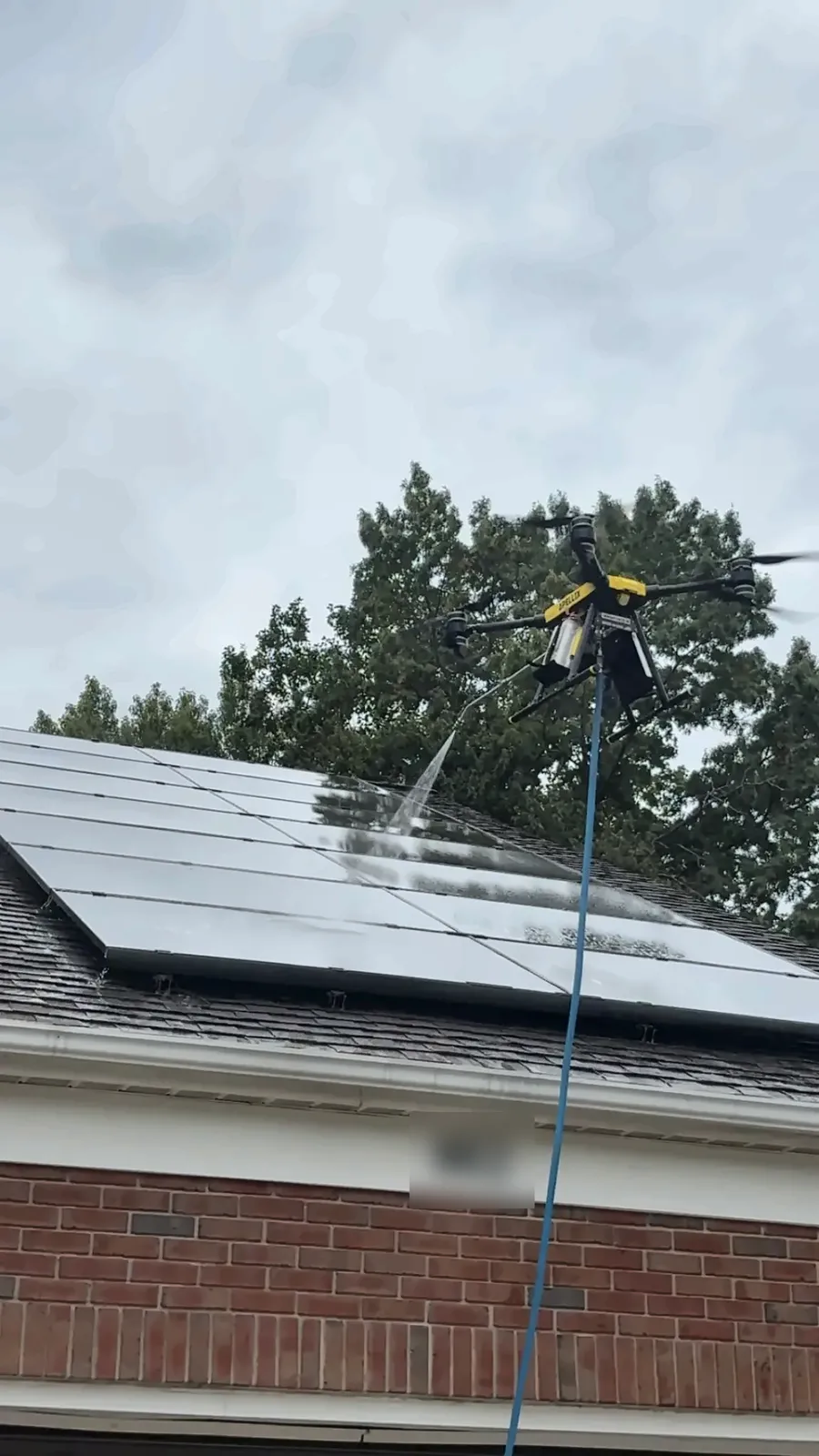
Is the array on a second-story roof, a steep roof, or slate? Then the two safe options are a rinse from the ground or a company that cleans without roof access.
How we clean solar panels
We clean residential arrays by drone, so nobody stands on the roof or on the panels. The drone pilots hold FAA Part 107 certification. The process has three steps:
- A tap water rinse takes off the loose pollen and dust.
- A wash with tap water and soap loosens the droppings, sap, and film.
- A deionized water final rinse takes the soap off. Deionized water has the minerals removed, so it dries without hard-water spots.
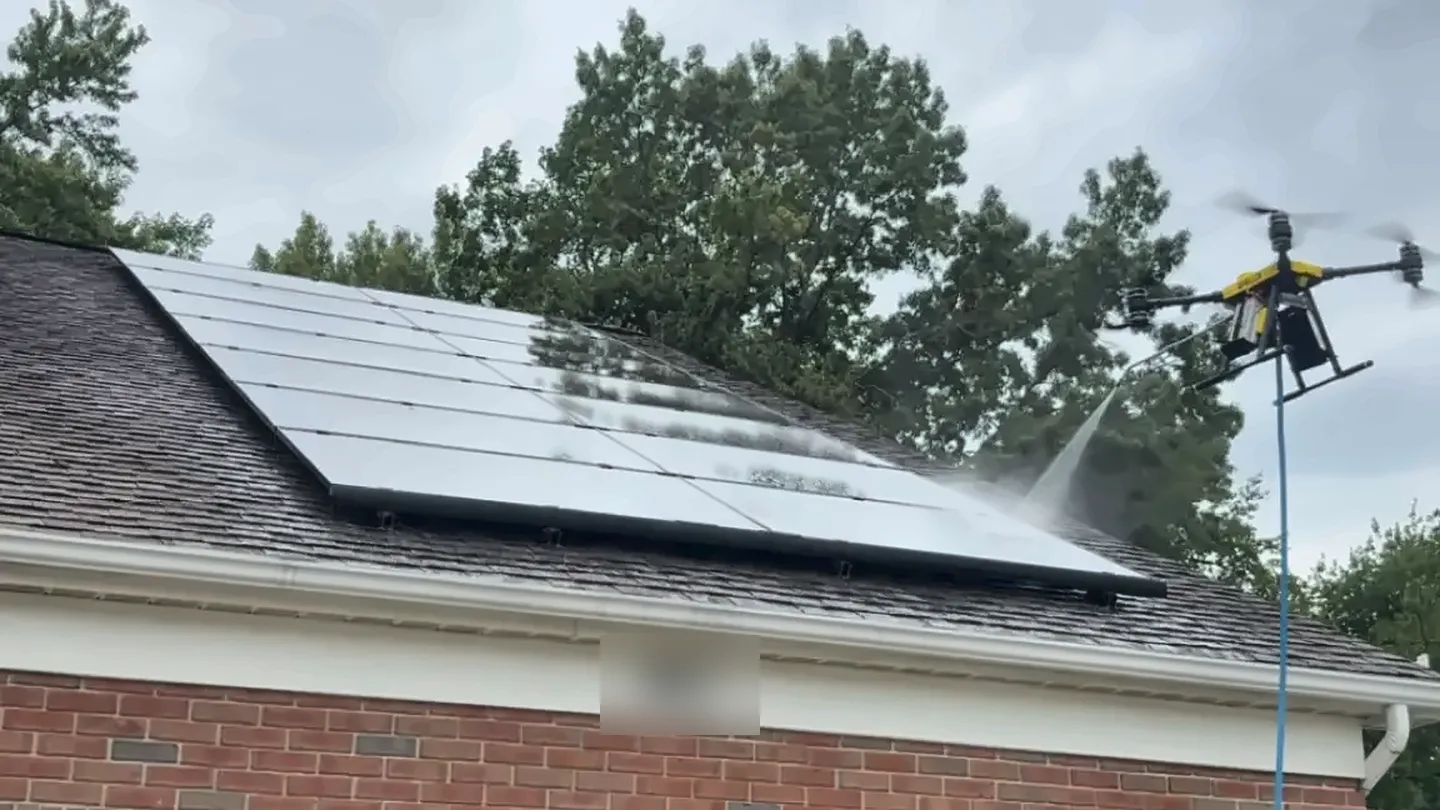
We do not pressure wash panels. Solar panel cleaning has photos of the drone at work. For the rules a cleaning drone flies under, see drone cleaning regulations.
Text a photo of your array to (610) 665-3995. We reply within 24 hours.