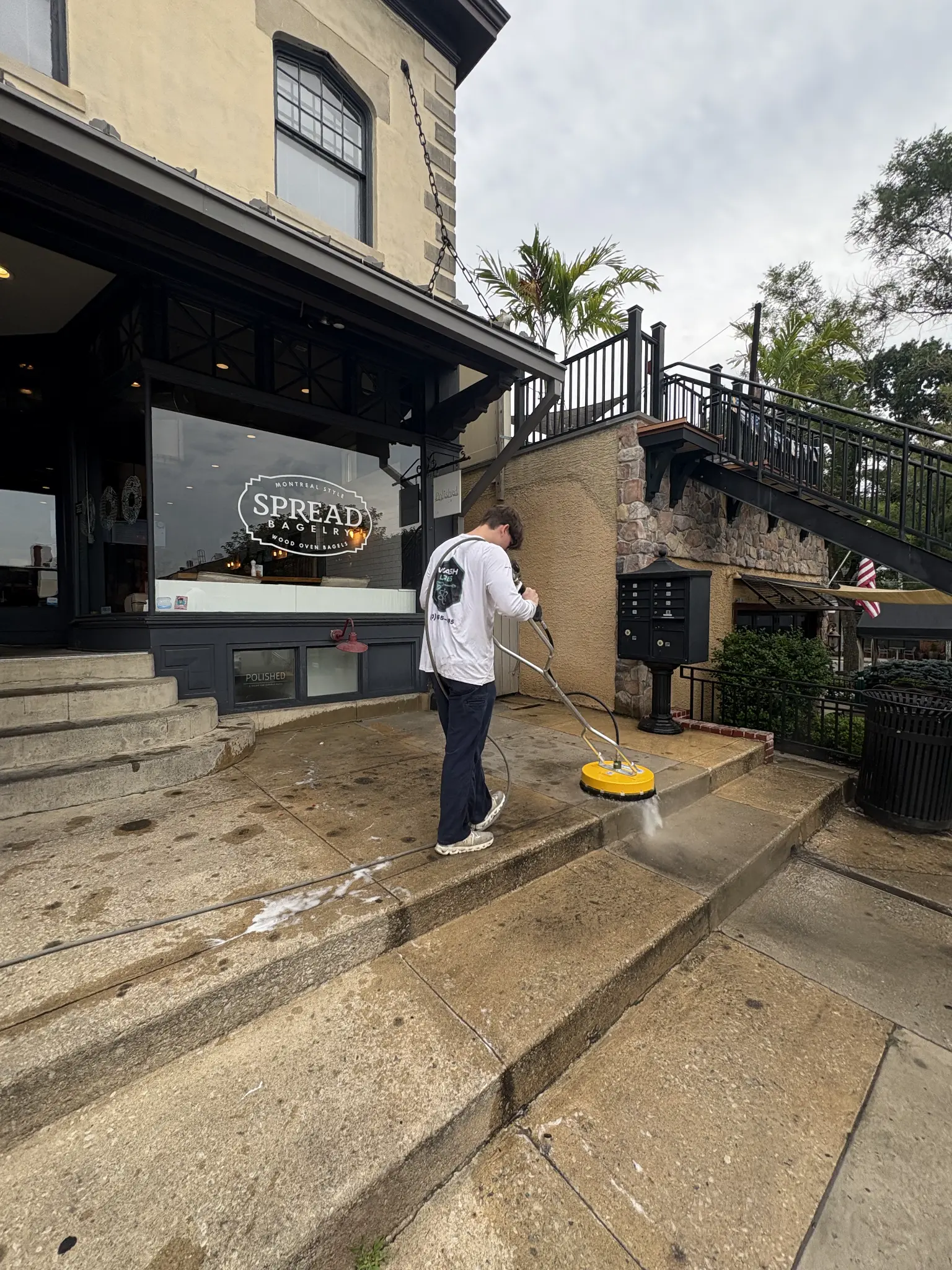
Patio & Walkway Washing in Delaware, Chester and Montgomery County
Flagstone and pavers each need a different pressure. Using one setting for both is how joints blow out.
Hardscape is the one place on a residential property where real pressure is usually the right answer, but the correct pressure depends entirely on the material. Poured concrete tolerates a lot. Bluestone and flagstone, common on older Main Line terraces, are softer than people assume and will fret at the surface if you hit them like a driveway. Pavers will lose their joint sand and start to shift.
We match pressure and technique to the surface, use a surface cleaner rather than a wand where the material allows it so you do not end up with zebra striping, and tell you up front if a patio needs re-sanding or sealing afterward.
Shade, moss, and the mid-Atlantic freeze-thaw cycle
A patio that spends most of the day in shade stays damp, and damp stone grows a black biofilm that is genuinely slippery. Most of the fall calls we get on hardscape are safety calls, not appearance calls.
Moss and weeds in the joints are the structural issue. Root growth pushes pavers apart and holds water in the joint. Water in the joint through a Pennsylvania winter freezes, expands, and lifts the stone. A patio cleaned and re-sanded before winter is meaningfully less likely to need resetting in spring.
Organic staining is the third category: tannin from oak leaves left through the winter, rust from furniture feet, and the dark ring under a planter that has not been moved in three years. Those need targeted treatment rather than more pressure.
Signs your home needs patio & walkway washing
- Black or green film that gets slick when wet
- Weeds or moss growing between pavers
- Tannin staining from leaves left over winter
- Rust rings under planters or furniture feet
- Joint sand washed out and pavers beginning to rock
- Efflorescence, the white powdery haze, on concrete or pavers
How we do it
Material and joint check
We identify the stone or paver type and check joint condition. Loose joints get flagged before we start, because cleaning will expose them.
Pre-treatment
Organic growth is treated chemically first so the pressure only has to remove what is already dead. That is what lets us use less pressure on softer stone.
Surface cleaning
Flat surface cleaner for even coverage where the material allows it, wand work for edges, steps, and detail. Pressure set to material, not to habit.
Rinse and recommendation
Full rinse and a straight answer on whether the patio needs re-sanding or sealing. We will tell you if the honest answer is no.
Where we do patio & walkway washing
We serve Delaware, Chester, and Montgomery County. Each town page explains what we actually see on homes there: the housing stock, the tree cover, and the schedule that makes sense for it.
Patio & Walkway Washing questions
Will pressure washing damage my flagstone?
It can, at the wrong pressure. Bluestone and flagstone are softer than concrete and will show wand marks or surface fretting if you clean them like a driveway. We drop the pressure and lean on the pre-treatment to do the work instead.
Do you re-sand paver joints?
We can, as an add-on with polymeric sand. Cleaning always removes some joint sand, so on a paver patio with open joints we recommend planning for it in the same visit rather than leaving the joints bare through winter.
Can you remove rust and tannin stains?
Usually. Rust from furniture feet and tannin from leaf litter both respond to targeted treatment rather than pressure. Stains that have been in porous stone for several seasons may lighten substantially rather than disappear, and we will set that expectation before we quote.
When should a patio be cleaned?
Spring, to clear winter tannin and get the joints sound before the season, or fall, to remove the slip hazard before the wet months. Either works. Doing it right before a party is common and completely fine.
Does the runoff hurt my lawn?
We pre-wet and rinse adjacent turf and beds, and direct runoff to vegetated areas rather than into a storm inlet. Pennsylvania stormwater rules treat a storm drain as a direct line to the nearest creek, and on the Main Line that creek is usually one you can walk to.
Do you offer patio cleaning near me in Bryn Mawr, and do you do paver cleaning and sealing?
Yes to both. Bryn Mawr is on our weekly route, and the rest of the Main Line is in the same service area. Paver cleaning and sealing is an add-on on the same visit.