House Washing in Delaware, Chester and Montgomery County
Soft washing that removes the green without stripping paint, mortar, or stucco.
House washing is the whole-exterior clean: siding, trim, soffits, fascia, shutters, porch ceilings, and the shaded elevations where algae takes hold first. On Main Line housing stock it is almost never a pressure-washing job. Stone with lime mortar, stucco, EIFS, cedar shake, and painted clapboard all fail under high pressure. The water drives past the surface and into the wall assembly.
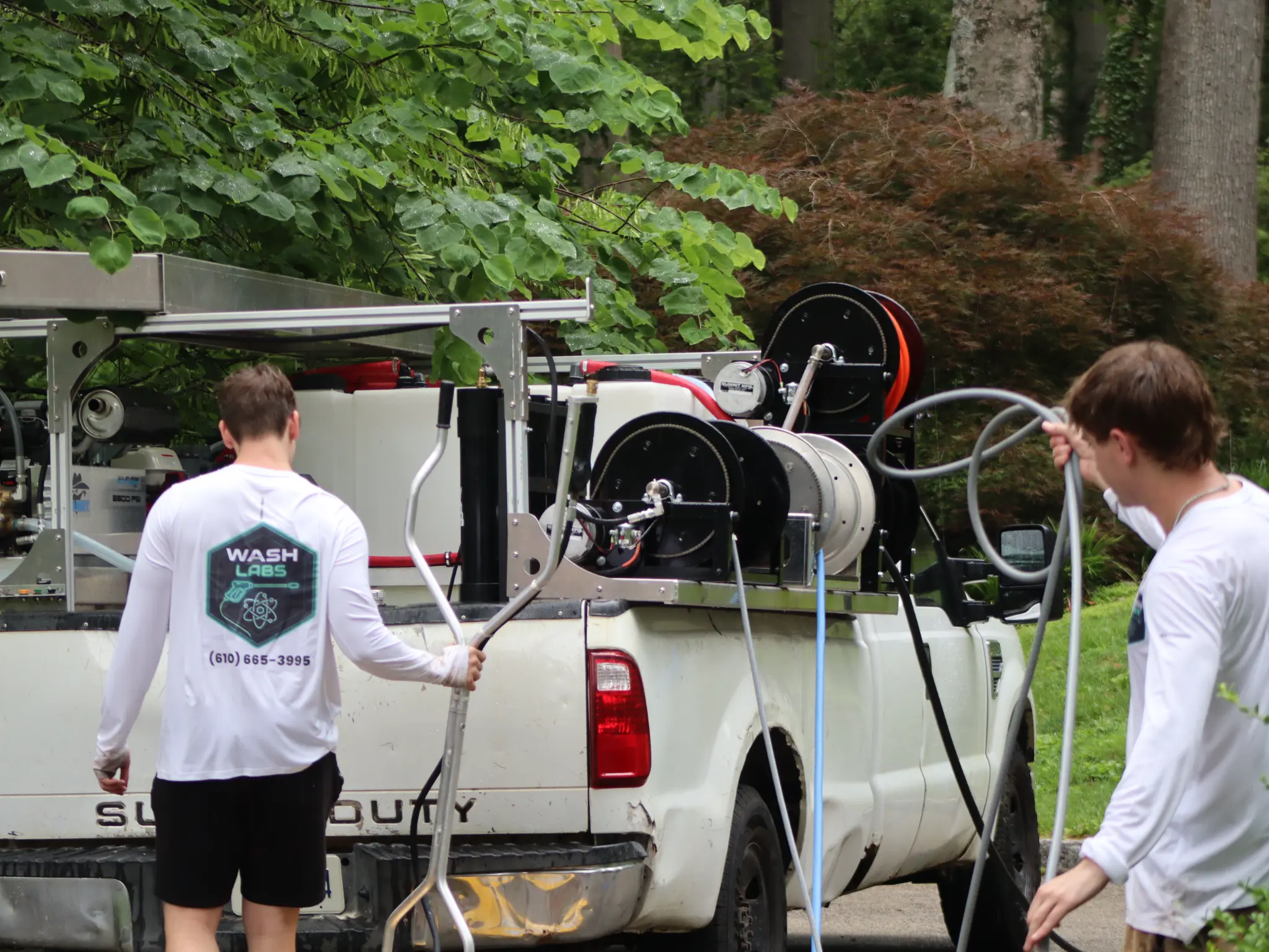
We soft wash instead: a low-pressure application of a cleaning solution that kills the organism causing the discoloration, followed by a rinse at garden-hose pressure. The color comes back because the algae and mildew are dead, not because the surface was blasted off.
Why homes here go green in the first place
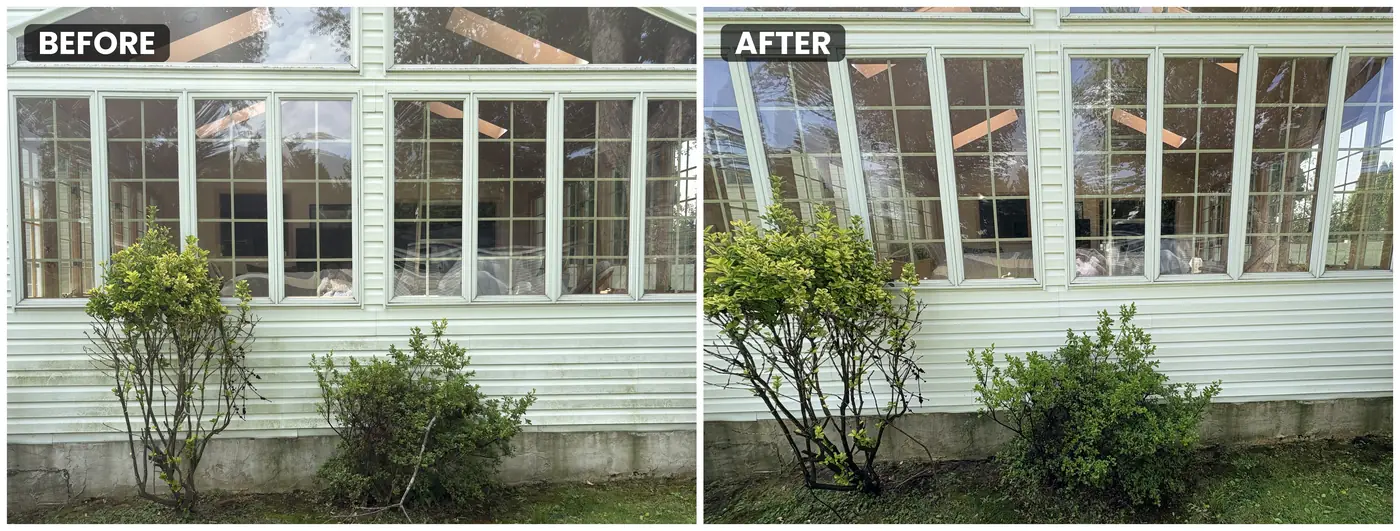
Southeastern Pennsylvania sits in a humid continental zone with a long shoulder season of warm, wet weather. That is ideal for Gloeocapsa magma and the mildews that colonize north- and east-facing walls, which get the least direct sun and stay damp longest after rain.
Mature tree canopy makes it worse. A house under 80-year-old oaks holds moisture against the wall for hours after a storm and gets a steady deposit of pollen, tannin, and leaf litter. The result is the familiar pattern: a bright south elevation and a north elevation that looks like a different house.
Left alone, the growth holds moisture against the substrate. On painted wood that means premature paint failure. On stucco it means staining that migrates into the finish coat. Washing on a regular cycle is cheaper than the repainting or remediation it prevents.
House washing by wall type
Fieldstone and Wissahickon schist set in lime mortar are common on pre-1940 homes in Haverford and Gladwyne. These walls get low pressure only, and we mix the solution for the mortar, not just for the stone. Lime mortar is softer than the stone around it, and high pressure pulls it out of the joints.
Three-coat stucco and EIFS look alike from the street, but they need very different treatment. EIFS is a thin finish coat over foam board. It dents, and it holds water where the finish is broken, so we check for cracks and open seams before anything gets wet. You see both on the newer homes in Malvern and Paoli.
Painted wood frame, common in Narberth and older parts of Paoli, needs the paint film cleaned without lifting it. Aluminum siding oxidizes into a chalky layer. It cleans well with the right chemistry, but it polishes into uneven shiny patches if someone scrubs it hard. Our guide to soft washing stucco, EIFS and vinyl siding goes into more detail.
When the ground will not take a ladder
On many Main Line lots, access is half the job. Ardmore twins often have a side yard that is narrower than a ladder needs to stand safely. Narberth lots are tighter still. Gladwyne has the opposite problem: wooded lots of an acre or more, with sloped ground and outbuildings. On Conshohocken hillside streets, the downhill side of a house can be three stories tall while the uphill side is two.
On those walls we apply the solution by drone or with long-reach equipment from firm ground. It is the same equipment we use on commercial buildings, used on a house that has no safe place for a ladder on one side. Read how drone cleaning works.
Signs your home needs house washing
- Green or black film on the north and east walls
- Dark streaking below gutter seams and window sills
- Chalky white haze on vinyl or aluminum siding
- Cobwebs and mud-dauber nests in soffit corners
- Paint peeling in the shaded elevations first
- Visible growth on porch ceilings and under overhangs
How we do it
Surface identification
We identify what the wall actually is, whether stucco, EIFS, stone with lime mortar, cedar, fiber cement, or vinyl, because it sets the solution strength and rinse pressure. Getting this wrong is what damages houses.
Landscaping protection
Beds, foundation plantings, and lawn adjacent to the work get pre-wet and covered. Runoff is directed to vegetated areas rather than a storm inlet.
Soft wash application
Solution applied top-down at low pressure and given dwell time. Drone-delivered on the elevations where a ladder would sit on soft ground or a slate roof.
Rinse and walk-through
Rinse from the top down, plants rinsed a second time, then a walk-through with you before we pack up.
Where we do house washing
We serve Delaware, Chester, and Montgomery County. Each town page explains what we actually see on homes there: the housing stock, the tree cover, and the schedule that makes sense for it.
House Washing questions
Will house washing damage my stucco?
Not the way we do it. Stucco and EIFS are the exact surfaces high-pressure washing ruins, which is why we soft wash them at roughly garden-hose pressure. The cleaning is chemical, not mechanical. On a home with known stucco issues we will tell you before we start if we think washing should wait until after remediation.
Can you soft wash a stone house with lime mortar?
Yes. Soft washing is the right method for original lime mortar. High-pressure washing strips lime mortar out of the joints. Low pressure and a solution mixed for the mortar clean the stone and leave the joints alone.
How long does a house wash last?
On a sunny, open lot in this area, two to three years. Under heavy tree cover, closer to 12 to 18 months on the shaded elevations. Homes near the Schuylkill or with dense foundation plantings regrow fastest.
Is the solution safe for plants and pets?
The solution is diluted and neutralizes quickly, and we pre-wet and rinse all vegetation. Keep pets inside during the application and for about an hour after. Koi ponds and water features get covered.
Do you wash the whole house or just the dirty side?
We quote the whole house by default because a single-elevation wash reads as a mismatch. If budget is the constraint we will price the shaded elevations on their own and tell you honestly how obvious the difference will be.
What time of year is best?
April through November for this region. The solution needs air temperatures above roughly 45 degrees to work properly, and late fall after leaf drop is a good window because you are cleaning off a full season of tannin at once.
Do you offer house washing near me in Devon?
Yes. Devon is on our weekly route, and the rest of the Main Line is in the same service area. Send your address and we quote within 24 hours.