
Moss on roof shingles is green, raised, and grows in soft cushions at the shingle laps, in the valleys, and on the shaded lower courses. It holds water against the roof and can lift shingle edges, so it is the growth to treat first. Black streaks on roof shingles are a different thing: algae, a flat stain that runs down the slope with the rain. Flat, crusty patches are lichen. You can tell all three apart from the ground with binoculars.
How to tell moss, algae, and lichen apart
Four things show up on a roof in this region. They look different enough to sort from the lawn.
Black streaks (algae)
Dark gray or black stripes that run straight down the slope, widest near the ridge and thinner as they go down. The stain is flat and level with the shingle. In this region it is almost always Gloeocapsa magma, a cyanobacteria that feeds on the limestone filler in asphalt shingles. It spreads along the paths the rain takes, which is why it makes stripes and not patches.
Moss
Green to brown, and plainly three-dimensional. It sits above the shingle like a small cushion or a carpet. Moss starts where water stays longest: the laps between shingles, the valleys, and the north-facing courses just above the gutter. It grips the granule surface with root-like threads and holds water against the shingle.
Lichen
Flat, crusty, round-edged patches that look almost painted on. The color runs from pale gray-green to yellow or orange. Lichen is a fungus and an alga living as one, and it bonds into the granule layer instead of sitting on top of it.
Debris and organic film
Leaves, pine needles, seed pods, and the brown film they leave behind. This is not growth, but it is often mistaken for it, and it feeds all three of the others.
Three quick tests settle most cases. Look at the edge: a stain fades into the shingle, while attached growth has a hard edge. Look along the slope from an angle, not straight up: moss throws a small shadow and algae does not. Look at the pattern: algae follows the water in stripes, while moss and lichen grow in patches wherever the roof stays damp.
Is moss on roof shingles harmful?
Yes. Of the four, moss is the one that damages the roof. Algae and lichen are mostly a looks problem. Moss is a water problem.
A moss cushion works like a sponge. After rain it keeps the shingle and the lap under it wet for days, while the rest of the roof dries in hours. As the cushions grow at the laps, they push up the lower edge of the shingle above. Water then gets under that edge, and in winter it freezes there and pushes the edge up further. Moss also sheds into the gutters, where it packs with leaves and slows the drain. Green clumps in the gutter below a slope usually mean moss is on that slope, even when the roof looks only stained from the ground.
Lichen is slow and rarely causes leaks, but it is the hardest growth to remove. Because it bonds into the granules, removing every trace tends to take granules with it.
What causes black streaks on a roof?
Black streaks on a roof are a living stain, not dirt or soot. The algae arrives as airborne spores, lands on the shingles, and feeds on the limestone filler that most asphalt shingles contain. Shade and moisture let it spread, so north slopes and slopes under trees streak first.
One sign confirms it is algae: a clean band below copper or zinc flashing. Rain washes metal ions down from the flashing, and the algae does not grow where those ions land. If you see a clean stripe under a chimney flashing or a ridge vent, you are looking at algae.
The streaks are cosmetic. They do not rot the shingle. But they come back without treatment and they spread across the roof each year. If the stain you see is rust, tar, or a dark patch around a chimney, it can be a repair problem and not a cleaning problem. Our guide on roof stains: cleaning or repair sorts those cases.
Where to look from the ground
You can read most roofs from the lawn with binoculars. Walk the full perimeter and check these places:
- North-facing slopes. They get the least sun and dry the slowest, so each type of growth starts here.
- Slopes under overhanging trees. The canopy drops leaves and blocks the air that dries the shingles.
- Valleys, where two roof planes meet and water and debris collect. Moss often shows here first.
- The lower courses above the gutter. They stay damp longest and take splash from a full gutter.
- The areas around chimneys, dormers, and skylights, where flashing slows the water.
- Any lower roof that takes the runoff from an upper roof. That flow path grows its own stripe.
- The north and east cheeks of dormers, often the shadiest part of the whole roof.
Look on an overcast day if you can. Direct sun flattens the contrast and hides the texture difference you are trying to see.
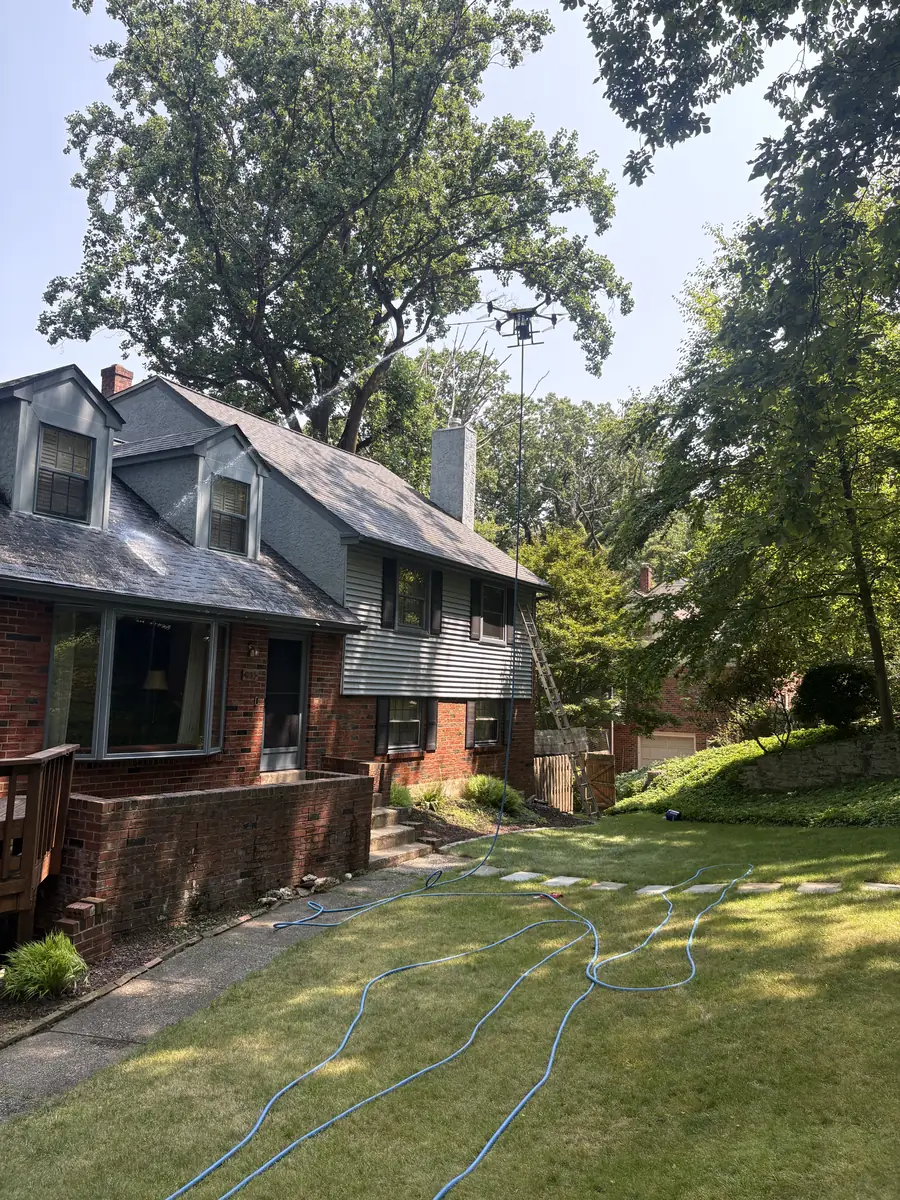
How moss and algae come off a roof
The method is a soft wash. A cleaning solution goes on at low pressure, stays on long enough to kill the growth, and the water does not hit the shingle hard. Each growth type reacts on its own schedule:
- Algae streaks usually lighten the same day and finish clearing over the next few rains.
- The solution kills the moss, but the dead cushions let go slowly. Rain washes them off over the following weeks. Pulling them off by hand takes granules with them.
- Lichen often fades but does not always fully clear. An honest assessment says so before the work, not after.
The solution that runs off the roof lands on the walls, the plants, and the lawn below. We soak the plants with water, or cover them, before the work and rinse them again after it. On many roofs we apply the solution by drone, flown by an FAA Part 107 certified pilot with reach to 190 feet, so nobody walks on wet, mossy shingles. A residential roof cleaning is typically $500 to $1,000. See roof moss removal for how the service works.
On the roofs we clean, the north side and the slopes under large trees always carry the most moss. Check those slopes first.
Slate and cedar roofs need a different approach than asphalt. See why slate roof cleaning is different.
When not to climb or scrape the roof
Do not get on the roof to check the growth. Everything above can be seen from the ground, and the extra detail from the roof is not worth a fall.
Do not pressure wash a shingle roof. High pressure strips the granules that protect the asphalt from the sun, and it drives water up under the courses. The roof looks clean for a season and then ages faster.
Do not scrape or rake moss off. The moss grips the granules, so scraping removes granules with it and can crack or lift the shingle edges.
Do not walk on a roof that is wet, mossy, steep, or made of slate or tile. Wet moss is as slick as ice, and slate cracks under a boot.
If a slope cannot be seen from the ground, that is a reason to have it looked at from a drone or with the correct access. It is not a reason to climb.
What to photograph before you ask for a quote
Six photos turn a vague request into a quote you can compare:
- One wide shot of each slope from far enough back to show all of it, on an overcast day.
- A zoomed shot of the worst area, taken from an angle so the texture shows.
- Each valley.
- Anything near flashing: the chimney, the dormers, skylights, and vent pipes.
- The gutter line and the ground below it, to show whether green clumps are coming down.
- The trees over the roof.
With the photos, note the roof material (architectural asphalt, three-tab, slate, cedar, metal), its rough age, any leak history, and whether it was cleaned before and how. Text the photos to (610) 665-3995. We reply within 24 hours with the method for the growth you have and what the roof will look like after it.