
How to clean roof shingles safely: kill the growth with a cleaning solution, then rinse at low pressure. The solution does the work, not the water. Do not use a high-pressure spray on asphalt shingles. It removes the granules and shortens the life of the roof. Before any wash, look at the stain. Black streaks, green moss and crusty lichen are growth, and they come off. A dark patch under a chimney, or a smooth bare area, is damage, and a wash will not repair it.
Is the stain growth or damage?
Most roof stains on the Main Line are biological and cosmetic. They sit on the roof, not in it. A smaller set of stains point to a leak, a failed flashing or worn shingles. The difference is the pattern. Growth spreads down the slope along the path the rain takes. Damage collects at one fixed point, and it frequently has a second sign in the attic, on a ceiling or in the gutter.
The difference matters for more than money. A wash on a roof with a water problem removes the stain that helps a roofer find the leak. It also puts hundreds of gallons of water onto a surface that already lets water in.
Read the stain with this list:
- Dark streaks that run down the slope are algae. On asphalt shingles this is usually Gloeocapsa magma, a cyanobacteria that feeds on the limestone filler in the shingle. Cosmetic. A soft wash removes it. Our guide to roof algae, moss, lichen and black streaks has photos of each.
- Green cushions at the shingle laps and in the valleys are moss. Moss holds water against the shingle and lifts the edges as it grows. Clean it soon.
- Crusty gray-green or orange patches are lichen. A wash kills lichen, but the outline can stay visible for a season.
- A dark patch directly under a chimney, skylight, vent or valley points to the flashing. Water collects or gets past a joint at that one feature. Ask a roofer first.
- A patch that looks smoother, shinier or a different shade than the shingles around it is granule loss. That is wear. A wash cannot put the granules back, and a hard wash removes more.
- Rust-colored streaks below a vent, fastener or metal part come from corrosion. The streak is cosmetic. The metal part above it is corroded.
- An area that stays darker than the rest after several dry days holds water. The deck under it can be wet.
- A sag, a wave or a soft-looking area in the roof plane is a structural problem.
How do you check a roof stain from the ground?
You can read most stains with binoculars and a phone camera on an overcast day. Do not climb onto the roof.
- Look at the shape. Growth spreads and follows the water. Damage stays at one point.
- Look directly above the stain. A chimney, skylight, vent stack, dormer or satellite dish above it makes the flashing the first suspect.
- Look at the texture. Growth adds texture. Granule loss makes the area smooth.
- Compare the slopes. Algae and moss are worst on the north and shaded slopes. A stain on the sunny slope is more likely something else.
- Look in the gutters and at the downspout outlets. A layer of granules there means the shingles are worn, not dirty.
- Look at the eaves and fascia. Stains, peeling paint or soft wood there usually mean gutter overflow, which is a gutter problem that shows on the roof.
- Go into the attic in daylight. Look for light through the deck, dark stains on the underside of the sheathing, or damp insulation. Then look at the ceilings in the rooms below.
How to clean roof stains on asphalt shingles
If the stain is growth, this is the method that cleans it without damage. It is the same process a soft-wash roof crew uses, at the same low pressure.
- Wet the plants, lawn and walls below the roof with clean water. Cover delicate plants. Wet leaves absorb less of the solution.
- Apply the cleaning solution at low pressure, from a pump sprayer or a soft-wash system, not a high-pressure wand. Most roof mixes are diluted sodium hypochlorite with a surfactant, which holds the mix on the slope.
- Let the solution dwell. Black algae streaks usually lighten during the dwell. Moss and lichen die on the roof and come loose over the next weeks of rain.
- Rinse at low pressure from the top down.
- Rinse the walls, windows and plants below again. Everything you put on a roof runs off onto the house and the beds under it.
Do not scrub the shingles and do not use a rotary brush. Both remove granules. Do not walk on a wet, mossy or steep roof. A wet roof with a cleaning solution on it is slippery, and your feet crush granules out of the shingle.
Where a roof wash is the wrong tool
Do not pressure wash asphalt shingles. High pressure strips the granules, and the shingle then ages quickly in the sun.
Do not wash a roof that leaks. The wash puts more water into the deck and removes the evidence a roofer needs.
Do not use an asphalt-shingle mix on slate, cedar or metal without checking the material first. Each takes a different mix and different handling. Our guide on why slate roof cleaning needs a different approach explains the slate case.
Stop and get a roofer to examine the roof before any cleaning if you see:
- A ceiling or wall stain inside, current or old, under the stained area
- Daylight through the attic deck, or dark stains on the underside of the sheathing
- Missing, cracked, lifted or curled shingles
- Lifted or open flashing at a chimney, skylight, valley or wall
- Granule loss over an area, not only at a few spots
- A sag or wave in the roof plane
- Soft or rotted fascia, soffit or eave trim
- A roof at or near the end of its service life
None of these rule out cleaning forever. They change the order: repair first, then clean. On a roof due for replacement in a few years, skip the cleaning and keep the money for the new roof.
What a roof cleaning assessment covers
When the answer is cleaning, a good assessment still looks at three things beyond the stain.
Material. Architectural asphalt, three-tab asphalt, slate, cedar shake, metal and synthetic shingles each take a different chemistry.
Access. Nobody stands on the field of the roof. A drone can apply the solution from above the roof plane. WashLabs flies under FAA Part 107, and the drones reach 190 feet.
Runoff. The plan says how the plants get pre-wet, how the siding and windows below get rinsed, and where the water goes after that. A roof wash that leaves streaks on the siding moves the problem to the walls.
On every roof we clean, the main thing is the plants. We soak them with water or cover them before the solution goes on, and we rinse them again after. The roof mix is sodium hypochlorite and a surfactant, at a higher strength than a wall mix, and it goes on at low pressure.
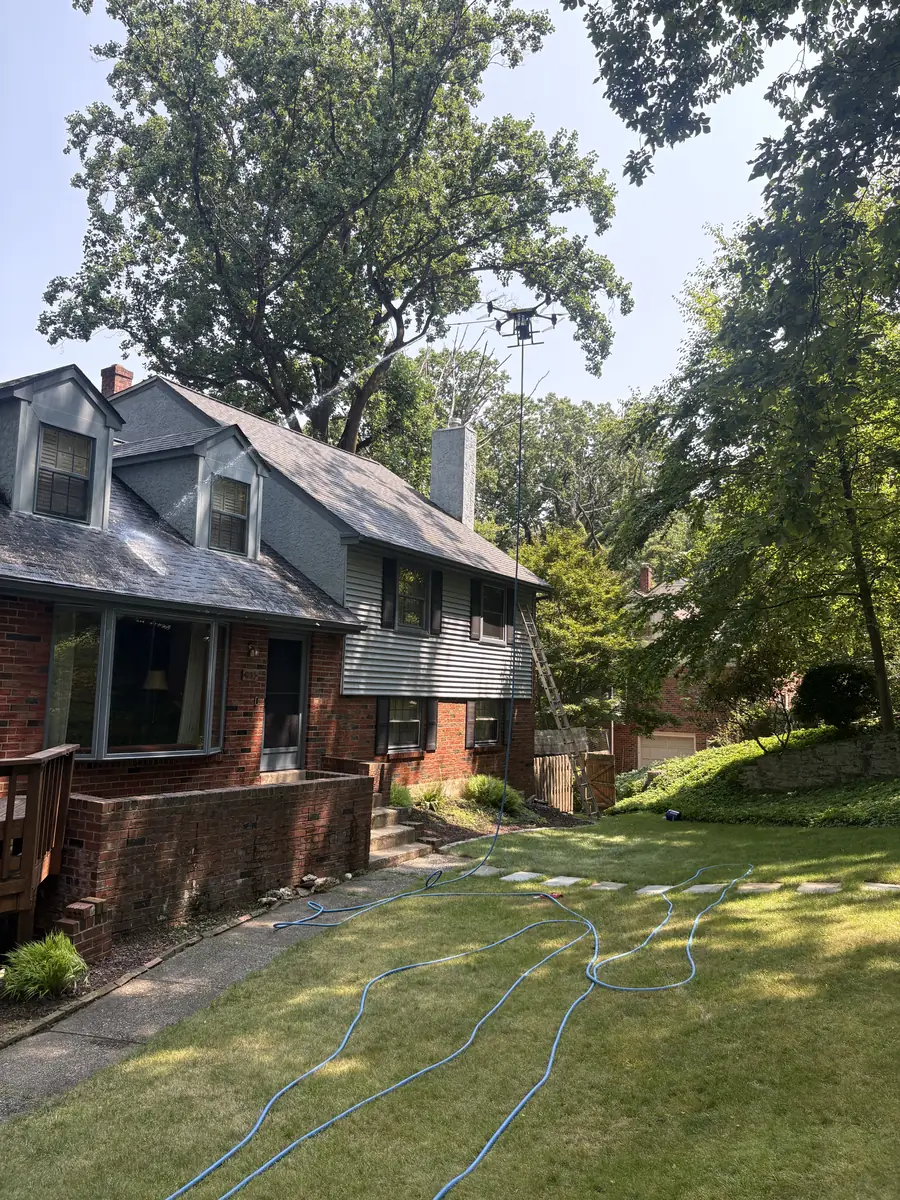
A residential roof cleaning is typically $500 to $1,000. If your stain is growth and you want the work done for you, see how roof cleaning works at WashLabs. Text a photo of the roof to (610) 665-3995. We reply within 24 hours.