
What is soft washing a house in practice? It is a way to clean the siding at low pressure, under 500 PSI. A cleaning solution kills the algae, mildew and moss. The solution stays on the wall for a few minutes. Then a low-pressure rinse carries the dead growth away. The water does not blast the surface, so vinyl, stucco and painted wood come out clean and undamaged.
What is in a soft wash solution?
The WashLabs soft wash mix has three parts. Sodium hypochlorite (SH), the active chemical in household bleach, kills the growth. A surfactant, which is a type of soap, makes the mix hold on the wall and not run straight off. Water cuts the mix down to the correct strength for the surface. A scent additive is optional, on request.
The strength changes with the surface and the growth. Vinyl with a light green film takes a weak mix. A north wall of stucco with thick black algae takes a stronger one. A roof takes a higher SH strength than a wall, still at low pressure. A mix that is too strong can fade painted trim and burn plants. Thus the person who sets the mix is as important as the chemical.
How is soft washing done? The steps on a house
- Examine each surface. Find out what the walls, the trim and the roof are made of, and how heavy the growth is. That sets the mix.
- Wet the plants. Soak the shrubs and beds near the house with plain water, so the leaves do not absorb the mix. Close the windows and move outdoor furniture away from the wall.
- Apply the mix from the bottom up. If you start at the top, the mix runs down over dry dirt and leaves clean streaks that are hard to blend later.
- Let it dwell. The mix stays on the wall for several minutes. The green and black fade as the algae die. Do not let the mix dry on the wall.
- Rinse from the top down. A low-pressure rinse carries off the dead growth and the mix.
- Rinse the plants again, and rinse any metal fixtures near the work.
On every soft wash, the plants are the main thing. We soak them with water or cover them before the mix goes on, and we rinse them again after. The north wall and the walls under large trees always carry the most growth, and they are the walls we check first.
Which surfaces get a soft wash
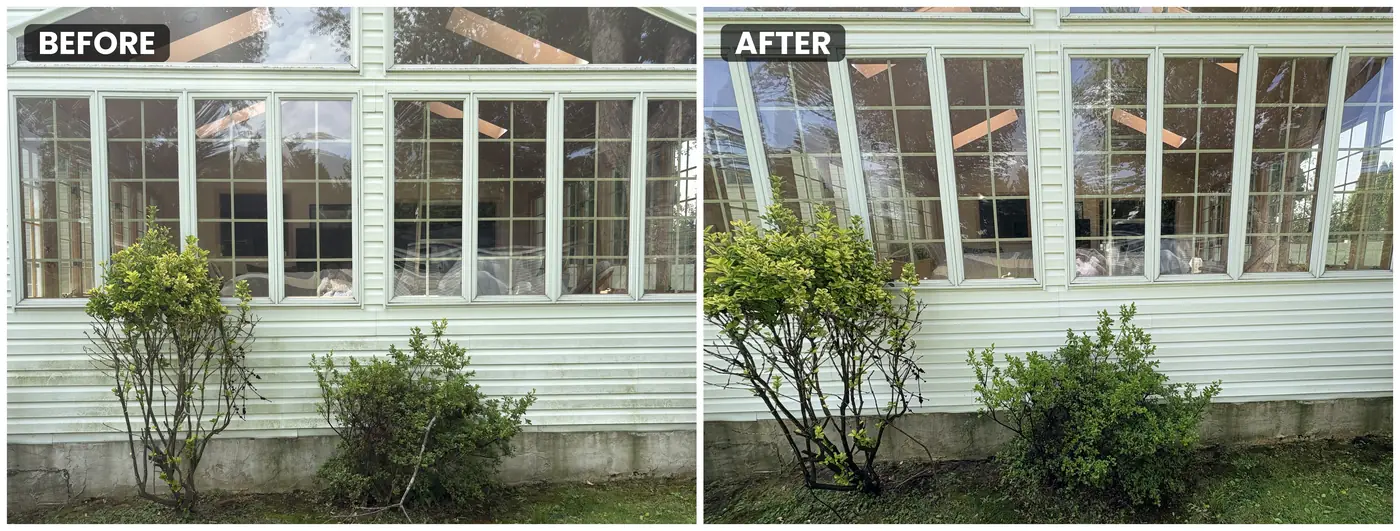
Vinyl siding is a standard soft wash job. High pressure pushes water behind the laps, where it stays out of sight. A soft wash cleans the face of the siding and does not drive water into the wall.
Stucco and EIFS get a soft wash because high pressure cracks the finish coat. EIFS is a thin coat over foam board, and a pressure wand can dent it.
Painted wood and cedar get a soft wash because high pressure lifts paint and tears the soft fibers of cedar.
Asphalt shingle roofs get a soft wash too. The black streaks on a shingle roof are algae, and high pressure strips the granules that shield the shingle from the sun. To tell algae from moss and lichen, read roof algae, moss and lichen: how to tell them apart.
What a soft wash does not remove
A soft wash kills living growth. Some stains on a house are not alive, and the mix does not touch them:
- Rust from iron in well water or a lawn sprinkler. Rust takes an acid-based cleaner, applied separately.
- Chalk on old vinyl or aluminum siding. This is the paint or the vinyl itself, broken down by the sun, and it comes off on your hand. A soft wash removes the loose chalk but cannot put the color back.
- Red clay and mud splash at the bottom of the wall. This is dirt, and it takes a rinse and sometimes a soft brush.
- Bird droppings and wasp nests under the eaves. These take a hand clean before or after the wash.
Soft wash vs pressure wash, in short
A soft wash kills the growth with a cleaning solution and rinses at low pressure. A pressure wash removes dirt with force, up to 4,000 PSI. Siding, stucco and roofs get a soft wash. Concrete driveways and brick pavers get pressure washing. For the surface-by-surface comparison, read soft washing vs pressure washing.
Where soft washing is the wrong tool
- Do not use a soft wash on bare concrete with oil stains. The mix kills algae but does not lift oil, and the stain stays. That job takes pressure washing and a degreaser.
- Do not use a soft wash on paint that is loose, flaky or chalky. The rinse lifts more of the loose paint, and the wall looks worse than before. Repaint first, then clean the next season.
- Do not apply the mix in full sun on a hot day or in strong wind. The mix dries before it works and leaves streaks. The wind also carries it onto plants and cars.
- Do not let the runoff go into a fish pond. Sodium hypochlorite kills fish.
- Rinse copper and aluminum right after the mix touches them. Bleach can discolor both metals.
How a drone applies a soft wash
With a drone, the steps stay the same and only the reach changes. WashLabs drones reach 190 feet, with a hose that runs from the drone down to the equipment on the ground. The drone puts the mix on a third-story gable or a steep roof without a ladder on the wall or a person on the shingles. WashLabs pilots hold FAA Part 107 certification.
On the Main Line, this matters most on slate and cedar roofs and on tall stucco walls under mature canopy. Those are the surfaces where a ladder or a person on the roof can do damage before the clean starts.
What soft washing costs
Soft washing is $0.35 to $0.70 per square foot on the pricing page. The surface mix, the growth level and the height move a house within that range. Concrete on the same property takes the pressure washing rate, $0.25 to $0.55 per square foot.
To have a house cleaned this way, see how soft washing works at WashLabs. Text a photo of the house to (610) 665-3995. We reply with a quote within 24 hours.